



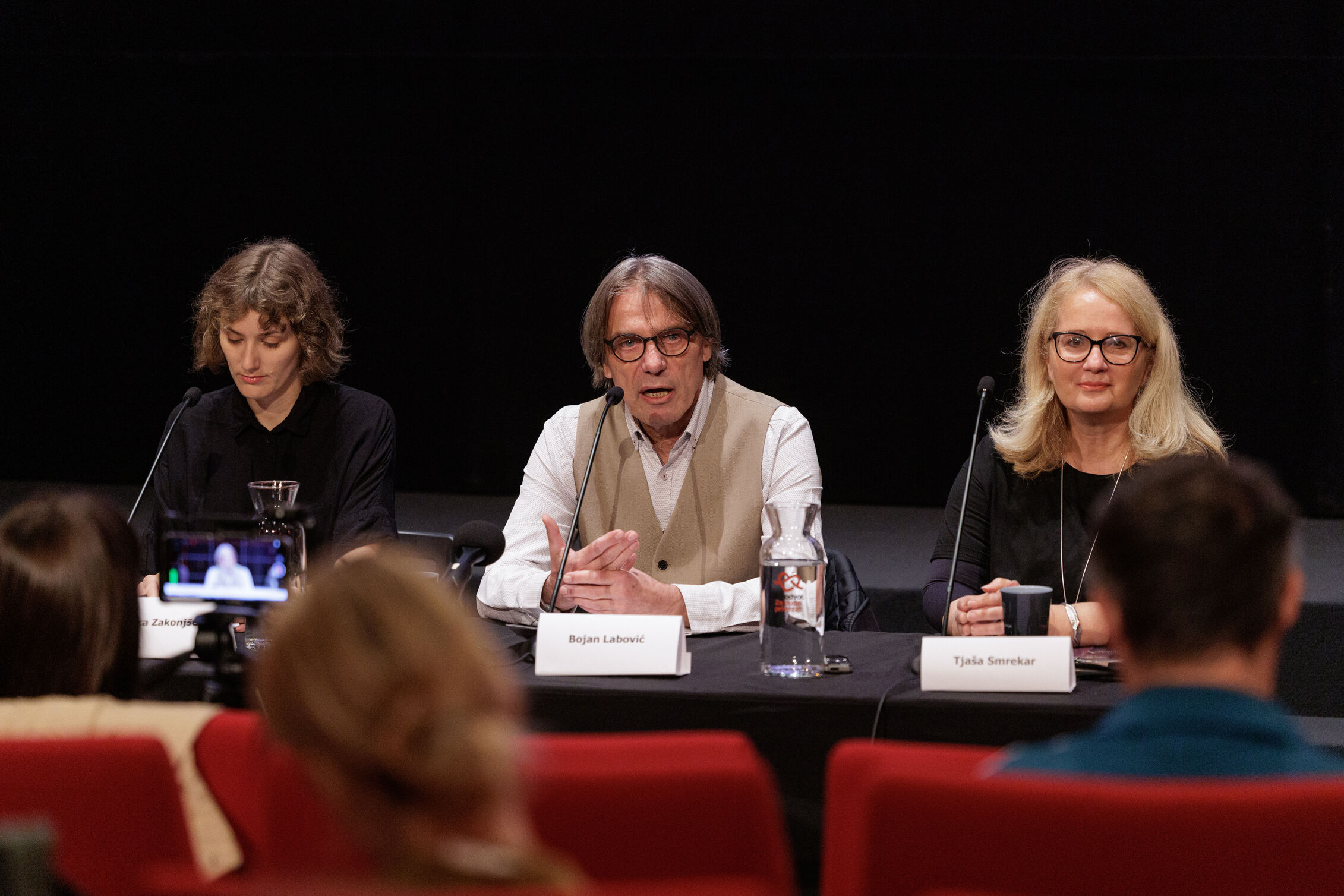
Press conference
On Tuesday, 6 October, at a press conference in Ljubljana, the director of the 29th Festival of Slovenian Film Portorož, Bojan Labović, project manager Tjaša Smrekar, and head of industry events, Veronika Zakonjšek, outlined the programme highlights for the 2026 edition of the festival.
According to Labović, showcasing contemporary Slovenian works remains the festival’s essential role for the foreseeable future: “Whatever happens to the festival, it will always be based on screening contemporary Slovenian films. Given the applicable rules, shaped also by the workings of international film power centres, the Festival of Slovenian Film cannot be – and is unlikely to become – a festival of premieres. When one thinks about it carefully, one realises that this does not really affect its significance much. Perhaps quite the opposite: by not getting bogged down in matters ‘around the film’, it has more time for what lies ‘within the film’,” underlined Labović, director of the 29th FSF Portorož.
Industry events remain a vital part of the festival. This year, they will discuss topics such as the role of AI in filmmaking and post-production, film heritage and digitisation, ethical standards in film production, and international cooperation. The festival will also celebrate 80 years of the University of Ljubljana Academy of Theatre, Radio, Film, and Television, and explore new international opportunities as part of ‘SloViet Connect: Cinema between Slovenia and Vietnam’.
The festival remains firmly rooted in Portorož and Piran, with screenings taking place at two venues: Avditorij Portorož and Magazin Grando. As the festival co-producer, Avditorij Portorož – Portorose, together with the Slovenian Film Centre and the Municipality of Piran, helps create a festival space which, in the words of Avditorij’s director Borut Bažec, goes beyond traditional cinemas and, by linking the venues, creates a unique ‘Slovenian cinematic lungomare’. As Bažec emphasises: “It is only through direct contact with the audience that the seventh art can remain an important part of our cultural landscape, even in the age of new technologies.”